
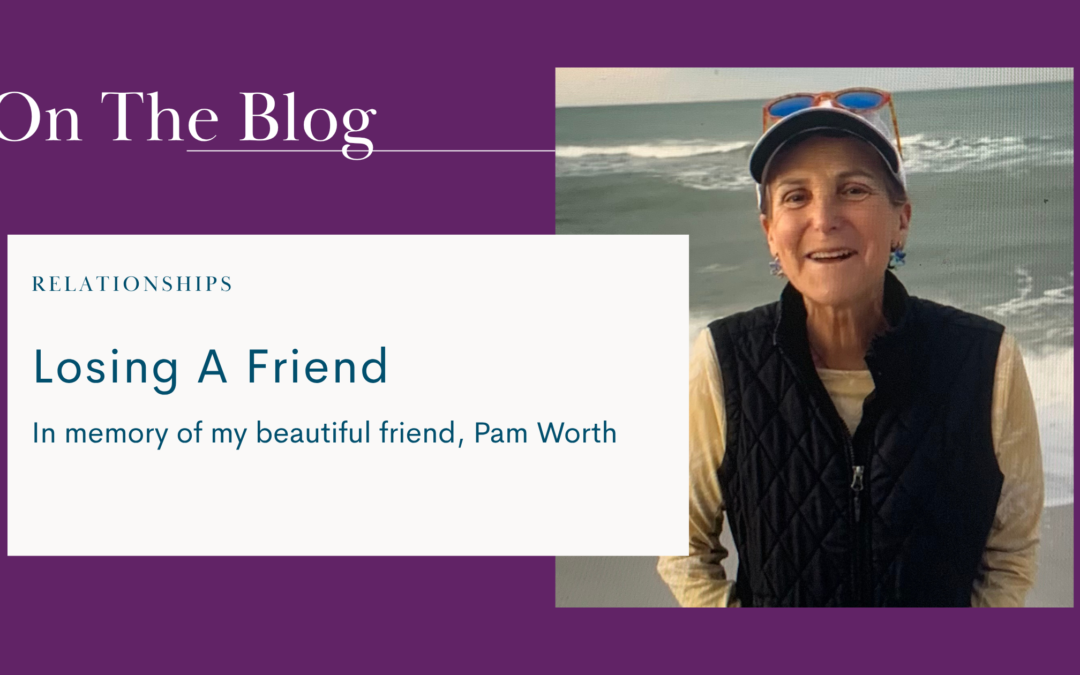
In late August, my husband and I lost one of our oldest and closest friends. Pam Worth died from multiple myeloma at 63 years old. We, and hundreds of others, were devastated. We are still grieving the loss of a vibrant, energetic, unique friend. She left behind four adult children and a husband, all of whom she loved with wild abandon, and who loved her back in the same manner. Her funeral was heartbreaking and also completely joyful, filled with over 300 people laughing, crying, and remembering someone who had touched all of our lives.
When we shared this brutal news with others, we were met with condolences and “We are so sorry for your loss.” I struggled with those condolences because I felt like maybe those words should be reserved for family members only. And yet, we were grieving as well. And then I realized that the loss of a dear friend is rarely discussed when we talk about grief. We talk about the sadness of losing our parents or siblings and the tragedy of the loss of a child. Yet losing a friend seems to receive limited attention in discussions of grief. Why is this?
It turns out there is a name for this experience. Grief researchers call it disenfranchised grief, a term coined by Dr. Kenneth Doka in 1989 to describe grief that isn’t openly acknowledged, socially validated, or publicly mourned. The death of a friend is one of the classic examples, because friendship is treated as a lower-status relationship than kinship, even when the bond runs just as deep. A 2019 study in PLOS ONE, Death of a close friend: Short and long-term impacts on physical, psychological and social well-being, followed bereaved friends and found declines in physical, psychological, and social well-being that lasted up to four years after the loss. Four years. And research by UCLA neuroscientist Dr. Naomi Eisenberger, published in Nature Reviews Neuroscience, has shown that the loss of a close social bond activates the same neural regions that process physical pain. In other words, our brains and bodies register this kind of loss as an actual wound. We are not being dramatic when a friend’s death knocks the wind out of us. We are grieving something real.
I love my friends deeply. They’ve gotten me through the hardest times of my life, and they’ve been with me for the happiest of celebrations. They are my go-to calls when I just want to chat or gossip. When I’m sick, they check on me, bring me food, and make me laugh. They’ve listened to me complain about my husband (sorry honey!), fret about my children, and worry about my parents. They give me life tips, home repair recommendations, and the truth on my wardrobe. I can’t imagine life without them. Life without our friend, Pam, will be so different from life with her.
Friends are often in place of, or alongside, our families. They are our chosen family, often without the dysfunctional history (sorry Mom and Dad!). My girlfriends are the sisters I never had, and I cling to them when life feels scary and overwhelming. Pam was a friend who listened deeply and gave advice whether I asked for it or not. I could tell her anything, and even if she didn’t agree with me, she was open to hearing all of it. I’ll miss her. My husband will miss her. We’ve suffered a terrible loss. Is our loss as profound as her family’s loss? No, but does one loss cancel out another? I don’t think so.
I’m sorry for our loss. I’m sorry for her family’s loss. Grief is the side effect of love, and so many of us loved her. A few months before Pam passed, she and I were discussing things we wanted to do this summer. At one point, she looked at me and said, “I just want to live.”
My face must have shown how scared and sad I felt when she said that because she changed the subject quickly. Live she did, not long enough for her or for those who loved her, but live she truly did. In her honor and in our grief, we will try to do the same. May her memory be a blessing.
If you want to see the incredible bravery and energy of our friend, Pam Worth, here’s the posts she did when she got diagnosed and almost every Monday after that until she passed.
https://www.instagram.com/sunrisemondays/?hl=en
Love,

Certified Professional Coach and Psychologist
____________________________________________________________________________________________________________________________________________________________________
How often have you wished for that person in your life who listens deeply, doesn’t judge you, and doesn’t try to fix you? That person who holds space for you to talk through your struggles, your hopes, and dreams so that you can live the personal and professional life that you truly want? I’m that person. Yes, I’m a psychologist and a professional life and leadership coach but my superpower is listening, deep, empathic, compassionate listening. If you’ve been seeking a professional listener who will help you live the life you truly desire, let’s set up a time to talk. My email is Lisa@LisaKaplin.com