
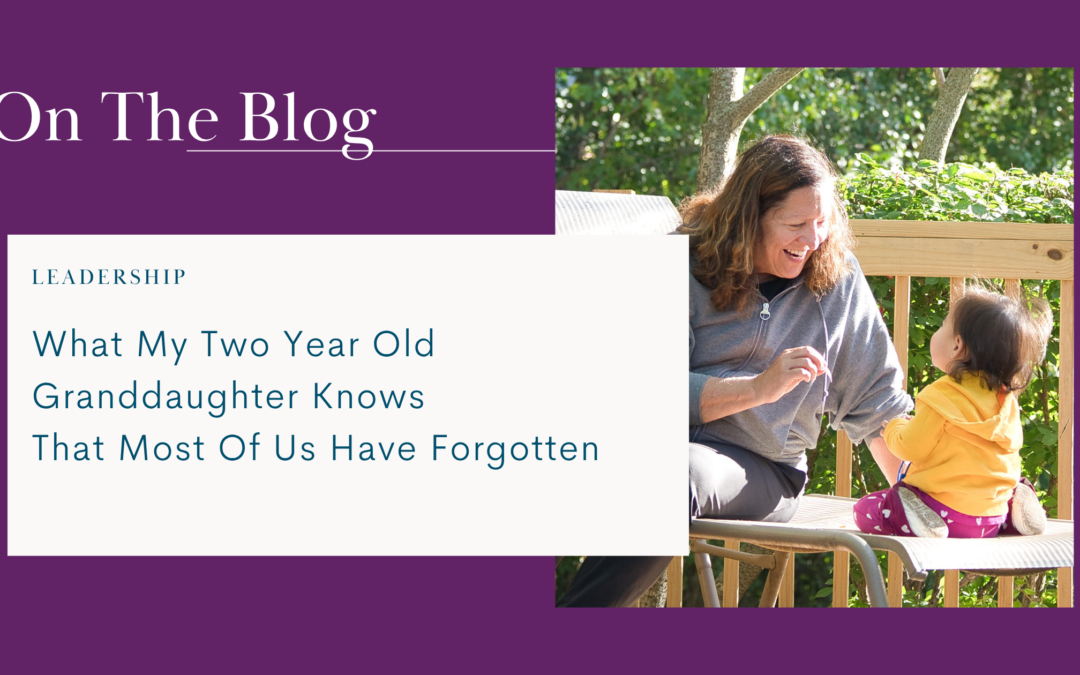
My granddaughter Nori is two. She calls me Mimi. She is small, opinionated, and wildly herself. And in the last several months, she has become one of my most effective teachers.
I coach executives for a living. I sit with senior leaders who are wrestling with hard conversations, big decisions, and the exhausting work of showing up as themselves in rooms that keep asking them to shrink or shape-shift. And I keep noticing that Nori, at two, has already figured out four things that most of my clients (and honestly, most of me) are still trying to relearn.
1. “No” is a full sentence.
Nori’s parents have taught her that her body is her own. If you ask her for a hug and she doesn’t want to give one, she looks at you and says, “No.” No explanation. No little chuckle to soften it. No offer of a high-five as a consolation prize. Just, “No. “The phrase “No is a complete sentence” is often attributed to Anne Lamott, who wrote it in her 2005 book Plan B: Further Thoughts on Faith. It turns out Nori was born knowing it.
I tend to add things after my no’s. I decline the meeting, then apologize. I turn down the extra project, then explain three times why my schedule is tight, then offer to help find someone else, then wonder if I should have just said yes. Research on workplace communication finds that women in particular are socialized into what linguists call hedging and softening language, padding requests and refusals with apologies and qualifications so we come across as less threatening. Some of that is strategic. A lot of it is just habit, and habit is expensive. Every “no, but here’s why, and I’m so sorry” costs me a little energy and a little clarity.
Nori doesn’t spend that energy. She has more to spend on the good stuff.
2. She feels what she feels, and she tells you.
When Nori is happy, you know. When she is furious, you know. When she is sad, she cries, and she doesn’t dress it up or check your face to see if it’s okay with you that she’s crying. She has not yet learned to manage her emotions for our comfort.
Developmentally, this window is real and it closes fast. Researcher Michael Lewis has spent decades documenting how self-conscious emotions like embarrassment and shame emerge in the second half of a child’s second year, right around Nori’s age, once children develop enough self-awareness to imagine themselves as an object of someone else’s attention. Nori is right on the edge of that. Most of us crossed over decades ago and never looked back.
Here is what the research keeps showing about what happens after we cross over. Stanford psychologist James Gross and his colleagues have found that habitually suppressing emotions doesn’t actually make them go away. It reduces the outward expression while leaving the internal experience intact, and it comes with real costs: more physiological stress, weaker relationships, less positive emotion, and more negative emotion overall. Hiding what we feel is not free. It just moves the bill.
Nori is not paying that bill yet. When she is done being sad, she is done. Nothing lingers.
3. She plays like nobody’s watching, because in her mind, nobody is.
Nori will make up a song about a piece of broccoli. She will narrate a whole story to a stuffed rabbit. She will dance in the middle of the kitchen with no discernible rhythm and no self-consciousness whatsoever. She is not performing. She is playing.
Most adults have lost this, and there is a specific psychological reason why. In 2000, psychologists Thomas Gilovich, Victoria Medvec, and Kenneth Savitsky at Cornell published a series of experiments identifying what they called the spotlight effect: our tendency to significantly overestimate how much other people notice and remember what we do, wear, and say. In their famous study, participants who wore an embarrassing Barry Manilow T-shirt into a room of peers assumed about half of the people would remember it. In reality, far fewer did. Everyone else was busy worrying about their own T-shirt.
The people you are afraid will judge your idea, your outfit, your dance moves, or your bad karaoke mostly aren’t thinking about you. They are thinking about themselves. Nori has the enormous good fortune of not knowing that yet, and I get to watch her live it.
4. She tells you what she wants, clearly.
Recently my husband and I were babysitting. I was putting Nori to bed and she got sad and missed her parents. I held her and let her cry. After a few minutes, she pulled back, looked at me, and said, “Mimi, leave now.”
I gave her a big hug and I left. She lay down and fell asleep.
She knew exactly what she needed. She asked for it in three words. She did not worry about hurting my feelings, or whether I would think she was ungrateful for the comfort, or whether “leave now” was too blunt. She just told me the truth about what she needed next, and trusted me to handle it.
That is executive presence. That is what I coach for.
What Nori Reminds Me
I don’t want to over-romanticize a two-year-old. Nori also loses her mind about the wrong color cup and has strong opinions about socks. Toddlerhood is not a leadership seminar.
But the adult work of becoming more direct, more emotionally honest, more comfortable in our own skin, and less concerned with being watched is, in some ways, the work of getting a little bit of Nori back. Not the tantrums. The truth-telling. The unedited self. The clean “no” and the clean “leave now.”
I am a coach, a psychologist, and a Mimi. It turns out the last title has taught me the most.
Love,

Certified Professional Coach and Psychologist
____________________________________________________________________________________________________________________________________________________________________
How often have you wished for that person in your life who listens deeply, doesn’t judge you, and doesn’t try to fix you? That person who holds space for you to talk through your struggles, your hopes, and dreams so that you can live the personal and professional life that you truly want? I’m that person. Yes, I’m a psychologist and a professional life and leadership coach but my superpower is listening, deep, empathic, compassionate listening. If you’ve been seeking a professional listener who will help you live the life you truly desire, let’s set up a time to talk. My email is Lisa@LisaKaplin.com