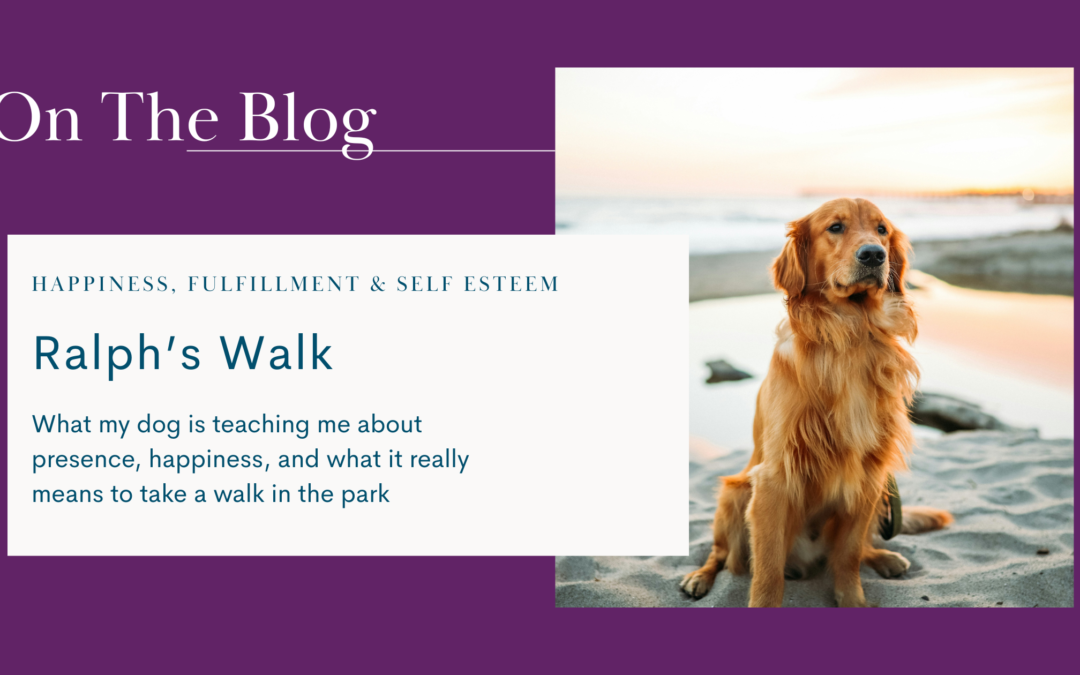
Most mornings, my dog, Ralph is a guest on my walk.
I set the pace. I set the direction. I’m the one holding the leash, and I’m the one deciding how long we stop when he catches a scent he cannot bear to leave. Which, if you have a dog, is roughly every three feet. I love him, but I have a workday to start, and I am impatient. I want to get the walk in. I want to get home. I want to get on with it.
One morning last week, I was running behind. My first meeting had been pushed, and for once, I had time. I decided, almost on a whim, that this walk would be Ralph’s, not mine. He would set the pace. I would follow.
What happened next was not what I expected.
Every time Ralph put his nose down and paused, I looked up. And when I looked up, I saw things. Green and gold fields. Trees I had walked past for years without really seeing. Wildflowers in colors I could not have named a week ago. I had Olivia Rodrigo’s new album in my ears, and I felt something I had not felt on a walk in a long time: a real, physical wave of joy and contentment.
I want to talk about why that happened, and what I want to carry with me on the days when Ralph does not get to be the boss.
What Ralph was actually doing
It turns out I have been misjudging my dog.
When Ralph stops to sniff a patch of grass, he is not being difficult. He is doing what his brain is built for. Dogs have roughly 300 million olfactory receptors compared to our six million, and they devote about forty times more brain volume than we do to processing smell. Sniffing is not a detour from the walk. For a dog, it is the walk.
There is a growing body of research on what behaviorists call “sniffaris,” or scent-focused walks. A 2019 study in Applied Animal Behaviour Science found that dogs who spent two weeks doing daily nose work performed better on cognitive bias tests, which is a measurable way of saying they were more optimistic. Free sniffing has also been linked to lower stress hormones, lower heart rate, and calmer behavior. When I hurry Ralph past a good smell, I am giving his body a workout and cheating his brain out of the part he needs most.
That alone was worth a moment of humility.
What was happening to me
But the more interesting question, at least to me, was what was happening to me.
Psychologists have names for what I felt when I looked up at those fields. Attention Restoration Theory, developed by Rachel and Stephen Kaplan, proposes that natural settings gently pull our attention outward, replenishing the depleted focus that meetings and screens burn through. Stress Reduction Theory, from Roger Ulrich, adds that exposure to nature physiologically lowers stress. I did not need a study to tell me my shoulders had dropped. It was nice to know there was a reason.
The bigger piece, though, was presence.
In 2010, Harvard researchers Matthew Killingsworth and Daniel Gilbert published a study using a smartphone app that pinged thousands of people at random moments and asked what they were doing, what they were thinking about, and how happy they were. Their finding has stayed with me for years. We spend about 47 percent of our waking hours thinking about something other than what we are doing, and we are consistently less happy when our minds are wandering, no matter what activity we are engaged in. Killingsworth put it this way: “How often our minds leave the present and where they tend to go is a better predictor of our happiness than the activities in which we are engaged.”
When it is my walk, my mind is already in the meeting. Already in the inbox. Already three tasks ahead. When it was Ralph’s walk, I was in the walk.
Bringing Ralph’s walk into my walk
I do not always have over an hour to let my dog dictate my morning. Most days I have about an hour and a full calendar. This is the piece I am still working out, and I want to share where I am landing.
I do not think the answer is to always let Ralph lead. Sometimes I really do need to get home. What I am experimenting with is something smaller: on my walks, when Ralph stops, I stop too, and I use his pause as my cue to look up. Not for the whole walk. Just for those few seconds. A micro-moment of presence, borrowed from my dog.
It costs me almost nothing. It gives me back a version of what I felt in the field.
There is a leadership lesson tucked in here, and I would be a poor coach not to say it out loud. The people I work with are almost always short on time. What they are not always short on is opportunities to look up. A pause between meetings. The walk from the parking lot. The two minutes before a hard conversation. Presence does not require a longer day. It requires noticing the pauses that are already there.
Ralph knew that all along. I am a slower student, but I am learning.
Love,

Certified Professional Coach and Psychologist
____________________________________________________________________________________________________________________________________________________________________
How often have you wished for that person in your life who listens deeply, doesn’t judge you, and doesn’t try to fix you? That person who holds space for you to talk through your struggles, your hopes, and dreams so that you can live the personal and professional life that you truly want? I’m that person. Yes, I’m a psychologist and a professional life and leadership coach but my superpower is listening, deep, empathic, compassionate listening. If you’ve been seeking a professional listener who will help you live the life you truly desire, let’s set up a time to talk. My email is Lisa@LisaKaplin.com.